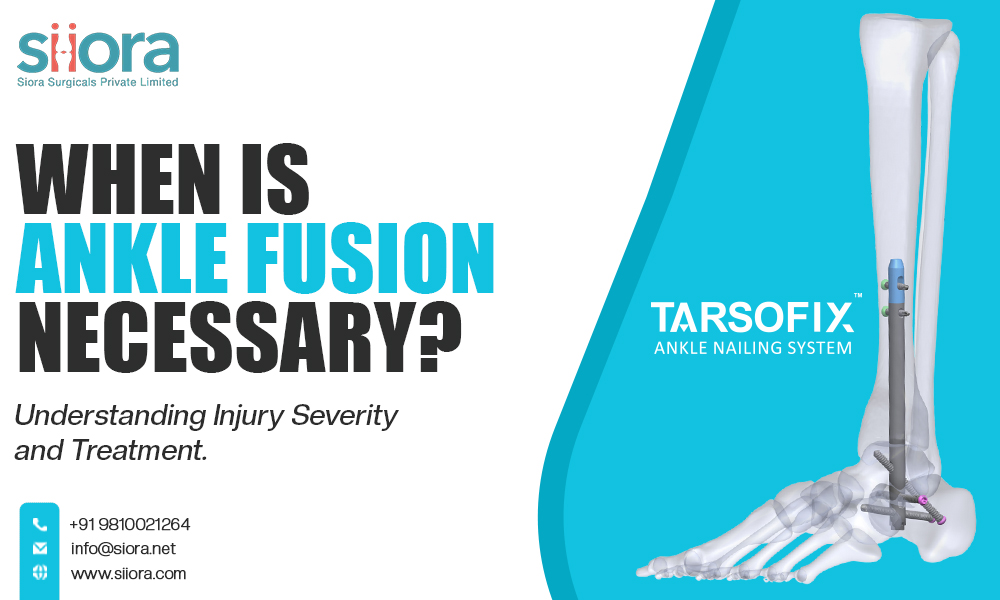
An ankle rarely gets much attention—until it starts hurting every time you stand up. For many patients, ankle pain begins as something manageable: a lingering injury, stiffness in the morning, or discomfort after long walks. Over time, though, that pain can become constant, limiting movement and affecting everyday life. When that happens, ankle fusion may become a realistic and effective solution.
Ankle nail fusion is not about rushing into surgery. It’s about recognizing when the joint has reached a point where keeping it mobile causes more harm than benefit.
Why Some Ankle Injuries Don’t Resolve on Their Own?
The ankle is a hardworking joint. It supports body weight, absorbs shock, and adjusts constantly to uneven surfaces. Because of this, serious injuries can leave lasting damage even after initial healing.
Fractures involving the joint surface, repeated sprains, or untreated instability can slowly wear down cartilage. As alignment changes, pain becomes more frequent and predictable. What once flared up only after activity may start appearing even at rest.
When pain is tied directly to joint movement, preserving that movement no longer serves the patient well.
Arthritis and the Breakdown of the Ankle Joint
Advanced ankle arthritis is one of the most common reasons surgeons recommend fusion. This condition often develops years after trauma but can also result from infection or structural deformity.
At this stage, the joint surfaces are uneven and worn. Every step causes friction instead of smooth motion. Patients often describe deep aching pain, swelling that never fully settles, and stiffness that limits daily tasks.
In such cases, eliminating painful motion through fusion can offer reliable, long-term relief.
When Previous Treatments Have Failed?
Ankle fusion is also considered when other surgical or non-surgical treatments fail to provide lasting improvement. Some fractures do not heal properly. Others heal but leave the joint unstable or misaligned.
Repeated procedures can increase frustration without solving the underlying problem. Fusion offers a more definitive solution when stability becomes more important than preserving motion.
Severe Deformity and Ongoing Instability
Certain conditions gradually change the shape and alignment of the ankle. As deformity progresses, walking becomes uneven, increasing strain on surrounding joints and soft tissues.
Fusion helps correct alignment and creates a stable base for weight-bearing. Although ankle motion is sacrificed, many patients experience improved balance and a more confident gait after recovery.
When Conservative Care Reaches Its Limit?
Before fusion is recommended, most patients have already tried multiple conservative options. Bracing, medications, injections, and physical therapy can help early on, but their benefits decrease as joint damage worsens.
When pain interferes with work, sleep, or simple daily movement—and imaging confirms advanced joint degeneration—fusion becomes a practical and well-established option rather than a last resort.
What Life Looks Like After Ankle Fusion?
One of the biggest concerns patients have is losing ankle movement. While motion is reduced, nearby joints often adapt over time. Many patients are surprised by how natural walking feels once constant pain is removed.
Rehabilitation focuses on gradual weight-bearing and strengthening. Most patients report improved stability, fewer flare-ups, and greater confidence during daily activities.
Is Ankle Fusion the Right Choice for Everyone?
Fusion isn’t appropriate for every patient. Age, activity level, bone quality, and overall health all influence decision-making. In some cases, ankle replacement may be discussed as an alternative.
However, when the goal is long-term pain relief and dependable stability, ankle fusion remains a trusted option.
Final Thoughts
Ankle fusion becomes necessary when joint damage reaches a point where motion causes more pain than benefit. It’s not about limiting mobility—it’s about restoring comfort, balance, and function.
For the right patient, ankle fusion can transform a painful, unstable joint into a solid foundation for everyday life.
If you want to know more about advancements in the orthopedic industry, visit WHX Dubai 2026.
 Siora Surgicals Pvt. Ltd.